

BALLOON FLIGHT ATTEMPT IN TATRA MOUNTAINS
In 1937 a stratospheric balloon flight was proposed in Poland. The Polish balloon aviation flourished thanks to the balloon and parachute factory in Legionowo, which used to make very good balloons. Polish aviators did very well in international balloon competitions, for example they won several times the Gordon-Bennett Cup. The military aviators proposed a balloon flight to break the world record of manned balloon flight altitude. The record was held at that time by an American aviator captain Stevens, who in 1935 flew to the altitude of 22 km. The military organizers of the flight were told that their flight might be possible if they had a serious scientific goal besides that of breaking the record of flight altitude. Prof. Mieczysław Wolfke of Warsaw Technical University suggested the cosmic ray study.
At that time a general picture of cosmic radiation was established as a stream of particles, mainly electrons in the atmosphere, which originate in collisions of very high energy cosmic particles in the upper atmosphere. The picture was however superficial, and further studies were very desirable. In particular, little was known about the penetrating component of the radiation, although a particle of this radiation, later called the muon, was already known.
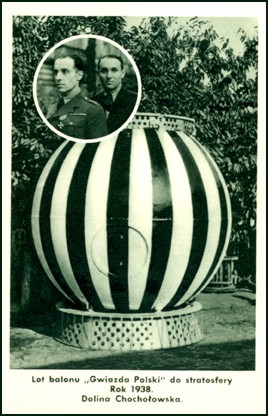
A Scientific Council of the flight was formed, including Prof. Mieczysław Wolfke and Prof. Szczepan Szczeniowski, and later also Prof. Marian Mięsowicz and Prof. Mieczysław Jeżewski as members. The council decided that the scientific goal of the flight would be a measurement of altitude dependence of cosmic ray intensity. Two types of detectors were used. The main part was a telescope composed of 30 Geiger-Muller counters - and building such a system at that time was an ambitions undertaking in itself. In addition, an ionizing chamber was used with photographic recording of tracks. The balloon was named "Star of Poland". The flight crew was captain Zbigniew Burzyński - an experienced balloon pilot, who won twice the Gordon-Bennett cup and set three international records - and Dr Konstanty Jodko-Narkiewicz, a cosmic ray physicist, traveler, alpinist and aeronaut, who participated in mountain expeditions to Alps, Andes, Africa and Spitsbergen.
The launch was planed for September 1938 in Chochołowska Valley in Tatra mountains. An attraction of the event was the presence of the world record holder, captain Stevens, who arrived to the town of Zakopane at Tatra foothills. Due to meteorological reasons, the launch was delayed many times. Finally, on 14 October the apparatus was installed in the balloon gondola and filling the balloon with hydrogen began.
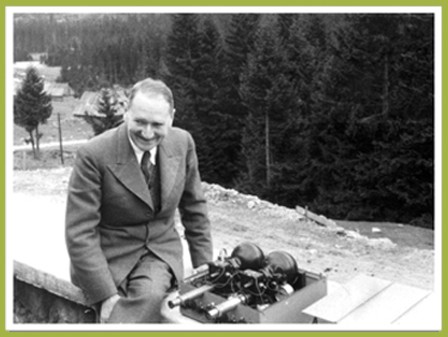 Prof. Stanisław Ziemecki and his ionization chamber which was installed in the balloon gondola.
The pilots come and took over. The scientists watched on from a terrace of the Chocholowska refuge as the balloon lifted off. Suddenly, the hydrogen gas ignited and balloon burned down relatively quickly. Luckily, there were no casualties. Although the gondola was at a distance of several tens meters from the balloon and was not damaged, the catastrophe annihilated the chance for a stratospheric flight. Although another flight attempt was planned for next year, the outbreak of the World War II prevented the flight.
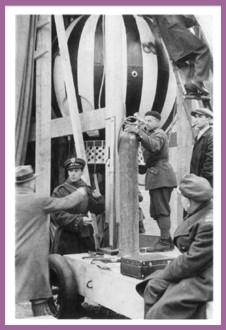 Preparing the balloon gondola for launch.
In center of the picture are pilot, captain Burzyński (at left) and physicist Jodko-Narkiewicz. They were the balloon crew.
Preparing the balloon gondola for launch.
In center of the picture are pilot, captain Burzyński (at left) and physicist Jodko-Narkiewicz. They were the balloon crew.
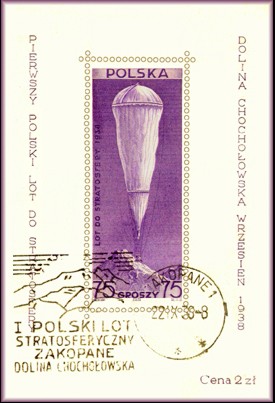 Blok ze znaczkiem upamiętniającym imprezę
 To publicize this undertaking and to collect funds for it, the Polish mail issued a post stamp featuring the balloon. A special post mark was used at Zakopane post office and at the Chochołowska Valley.

|
 |
 |